Overcoming barriers to employment: Improving representation of autistic people in the workforce
APRIL 22, 2022
As companies around the world strive to build more inclusive workforces, they shouldn’t overlook autistic individuals, who have fresh perspectives and unique skill sets.
“Neurodiversity is another type of diversity,” says Todd Simkover, a Toronto-based autism consultant, writer and speaker who was diagnosed with autism at age 15. “There are many advantages to having a diverse group of employees – hiring people of different abilities is an added benefit to everyone.”
Simkover, who holds an M.A. in Critical Disability Studies from York University, spent many years working for organizations such as Kerry’s Place Autism Services and the Geneva Centre for Autism. But he is an exception. When it comes to employment, many autistic people are not as fortunate, and struggle to find and maintain long-term, meaningful work.
Researchers estimate that between 70 and 90 percent of autistic people are unemployed or underemployed in Canada. The reasons behind this are complex. The problems start with the job application and interview process, which are usually structured in a way that doesn’t accommodate neurodivergent people.

Todd Simkover has a Toronto-based autism consulting business

People on the spectrum do better when there can be flexibility in terms of how a question is answered. There should be creative ways for candidates to show their abilities.
“The biggest challenge is how individuals on the spectrum tend to present in an interview,” says Simkover. For example, autistic individuals may not make eye contact and may have touch sensitivities, which places them at a disadvantage with an interviewer who expects eye contact or a handshake.
“For jobs that are more competitive, people on the spectrum who come across as awkward are less likely to get those jobs because interviewers are looking for certain traits – like someone who presents as confident – and that creates a barrier,” Simkover explains.
Challenges after the interview
The obstacles don’t end with the interview process. Once an autistic person is hired in a professional role, they must contend with other challenges.
“The ambiguous social component in the workplace is difficult for people on the spectrum,” says Simkover, acknowledging this also depends on the nature of the job. “I call this the ‘water cooler’ aspect of many jobs – communicating, being comfortable and fitting in socially.”
Because of difficulties navigating social situations, Simkover says many intelligent, highly capable autistic people have trouble maintaining a job. To illustrate his point, Simkover uses the example of a neurodivergent friend who is highly intelligent but works in a grocery store.

Simkover has an M.A. in critical disability studies from York University
“This person has excellent writing skills, but because of their tremendous anxiety, couldn’t complete their master’s degree,” says Simkover. “They’ve been working for several years as a cashier among other things – they are incredibly underemployed.”
Extreme anxiety can be another limiting factor. Simkover notes that while autistic people might successfully maintain a part-time job on a long-term basis, a full-time role can trigger stress and lead to an autistic person quitting or facing performance issues in their role.
Advice for hiring managers and autistic job seekers
Both employers and autistic people lose out when workplaces don’t make accommodations to include neurodivergent employees. Meanwhile, those who do are reaping significant rewards. After implementing a program to access neurodiverse talent, Hewlett Packard Enterprises (HPE) observed that the organization’s neurodiverse software testing teams are 30 percent more productive than other teams, according to an article in Harvard Business Review.
“Many individuals on the spectrum tend to be highly reliable, punctual and trustworthy,” says Simkover. “They can be more honest in general and very easy to get along with.”
Simkover has several recommendations for hiring managers:
- Employers should be more flexible with the interview process. Sharing interview questions ahead of time will help an autistic job candidate prepare and will go a long way toward easing their anxiety during the interview.
- Job descriptions should be clear and relevant. A qualified neurodivergent job candidate may have excellent written communication skills but may struggle to communicate verbally. If speaking isn’t an important part of the job, the candidate’s verbal communication skills shouldn’t be evaluated during the interview.
- Interviewers should steer clear of abstract or hypothetical questions like “where do you see yourself in 10 years?” which aren’t directly relevant to the job. An autistic person is better able to answer specific, well-defined questions that focus on the job tasks and responsibilities.
We need to support people with developmental disabilities in finding rewarding jobs. This will also give them a sense of autonomy and pride, allowing for a greater quality of life.
As for autistic job seekers, Simkover cites advice provided by American scientist Dr. Temple Grandin, who has documented her own personal experiences as an autistic person. Where relevant, Dr. Grandin recommends that autistic job seekers bring a portfolio that displays their best work, so they can show interviewers their skills.
“People on the spectrum do better when there can be flexibility in terms of how a question is answered,” says Simkover. “There should be creative ways for candidates to show their abilities.”
New initiatives bring hope
Some employers have already revamped their hiring process to be more inclusive of neurodiverse candidates. Aside from HPE, large corporations such as Microsoft, SAP and Walgreens have implemented programs specifically aimed at hiring autistic individuals.
Additionally, organizations like Employment Works and Autism Ontario help autistic individuals with skills training, hands-on job experience and job placement resources and support. The national initiative Ready, Willing and Able (RWA) connects Canadian businesses with qualified individuals who are autistic or have other intellectual disabilities. RWA is active in 20 communities across Canada.
“Over the last five to 10 years, I’ve seen a lot more initiatives to reach out to the autism community to level the playing field with recruitment,” says Simkover. “We need to support people with developmental disabilities in finding rewarding jobs.” He adds this will give them a sense of autonomy and pride, allowing for a greater quality of life.
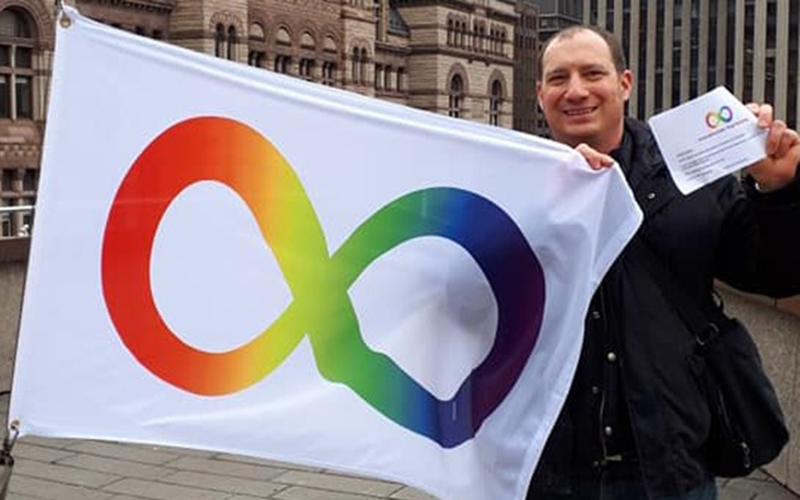
Simkover advocating in the community
Want to Access Autism Services?
Call our Children & Youth Intake 1-833-575-KIDS (5437)

 Invert Colors
 Dark Contrast
 Low Saturation
 Highlight Links
 Text Spacing
 Text Size
 Readable Font
 Reading Cursor
 Line Height
 Text Alignment
 Align Left
 Align Center
 Justify Text